Sunday, April 1, 2018

A Nameless Dwarf


I suppose I should have taken a more flattering picture of this.

Here:


A few years ago, I found an interesting broom in a Pinus ponderosa.  The resulting seedlings (those which were not eaten by the slugs) were not visibly dwarfed, except for this individual.  Its needles are less than 1/4 the length of a normal individual.  It is only three years old, but the internodes (the amount of growth each year) are quite small.  I think that this plant will end up being a true dwarf.

Its siblings are all much larger.  Only one is visibly typical.  Here it is, compared to the dwarf:


The others are still kind of ambiguous, though I think their true nature will become apparent during this growing season.  Some of them have more lateral buds than normal- another sign of dwarfing.


I think I may actually prefer to grow out seeds from brooms as a way to produce new plants.  The results are sometimes surprising.  I will have to get out in the woods and hunt down some more brooms with cones this year!

Monday, July 10, 2017

Evelyn's Find


Several years ago, Dad did some logging on his property.  He cut down a lodgepole pine that was crowding a western larch.  When the pine fell away, he noticed that the larch had an unusual, weeping form.  He told me that he wanted me to name it Evelyn's Find, after his friend Evelyn, who found the tree to be particularly delightful.

I was skeptical, as I mentioned in a previous post.  I couldn't tell if the weeping habit was just due to having been shaded out by a larger tree.  For the past several years, I've been on the fence about this one.

The other day, I happened to notice it.  The light was fading, so a good picture wasn't really possible with my phone.  I took the picture anyway. (I'll try getting a better one later.)


The branches gracefully weep, and have a spidery outline.  This tree has some potential, and needs to be grafted and observed further.

I think it is time to propagate 'Evelyn's Find'

Thursday, June 22, 2017

A Good Sign

Last year, I noticed a variegated leaf on my witch hazel.

This spring, the first two leaves from that shoot were plain green.  Then, the following leaf developed.


The question now is whether all the leaves will be like that, or just one leaf every third time :)

Either way, I think it will be a good plant.

As I've said before, only time will tell!

Thursday, May 25, 2017

Cherry Broom

I've been at my new job a couple of years now.  One of the best parts about it is that I get to drive to work on country roads every day.  When you drive along the same stretch of road, you get plenty of opportunities to spot unusual plants.

In the middle of last year, I discovered a broom in a hardwood tree on the road to work.  I would see it every day for a few months before I stopped to see what species it was.  It is on a treacherous stretch of road with very little room to pull over.

It turns out that it is a cherry tree- Prunus avium.  This species is from Europe, but it has naturalized in the US in places with suitable climates.  The wild ones grow into large forest trees with smaller fruit than cultivated varieties.


Here it is from a different angle.  


Last winter, I collected scions to store in the refrigerator until spring.  When I brought them out to graft, however, I saw that they had already come out of dormancy.  I grafted them anyway, just in case.  They failed.  I've found that plants will sometimes come out of dormancy at the right time, even when they are being held in a constant cold temperature in the refrigerator.  It makes me wonder what other cues in the environment trigger the internal clock of plants.  Had it already begun the process in late winter, so it just followed through?  Or does it just somehow count the days?

Luckily, fruit trees are much easier to graft than conifers.  I will have a second chance to graft this plant again in late summer.  At that time of year, I can do bud grafting, which is actually easier.  I have a much better success rate with Prunus while using this kind of grafting. 

I have to ask myself if brooms like this one, or the plum I found a couple of years ago, will yield anything useful at all.  There are many ornamental cultivars of cherries and plums.  These, if they even bloom- will have simple, single flowers.  As I'm writing this, I wonder if these brooms could be useful for dwarfing rootstocks.  Or perhaps I could use them as breeding stock to cross with the more ornamental varieties that already exist.  When you combine plant hunting with breeding projects, it seems that there are so many possibilities- far more than one can explore in a lifetime.


Thursday, May 11, 2017

Raw Materials

Sometimes, I find a mutation that isn't spectacular.  Normally, I might collect a cutting and just see how it does in the garden.  I may just let it grow there as an oddity.

Well, to be honest, it isn't like I am commercially producing these plants.  I have shared a few of them- but mostly, they just sit in my garden.  I have fantasized about starting a nursery, filled with odd forms of native plants- probably after I retire.  I don't know if such an enterprise would be very lucrative, but it might give me something to do when I'm an old man.

In the meantime, I just do this for fun.  I share my findings with friends and other plant geeks.  My understanding of the patent laws with plants is that you can't patent something you found in the wild.  If you spent effort breeding it, or it is a mutation you find among your cultivated plants, however, it is possible to patent the clone and make money from it.  Doing that doesn't seem likely to be worth the effort, unless you develop something really fucking amazing.

I have a few plant breeding projects going.  Hopefully, one will produce something spectacular in the future.  Mostly, I just want the satisfaction of making something spectacular.  it would be cool to see something in other people's gardens- people I don't even know- and be able to say, "oh yeah- that's my plant."

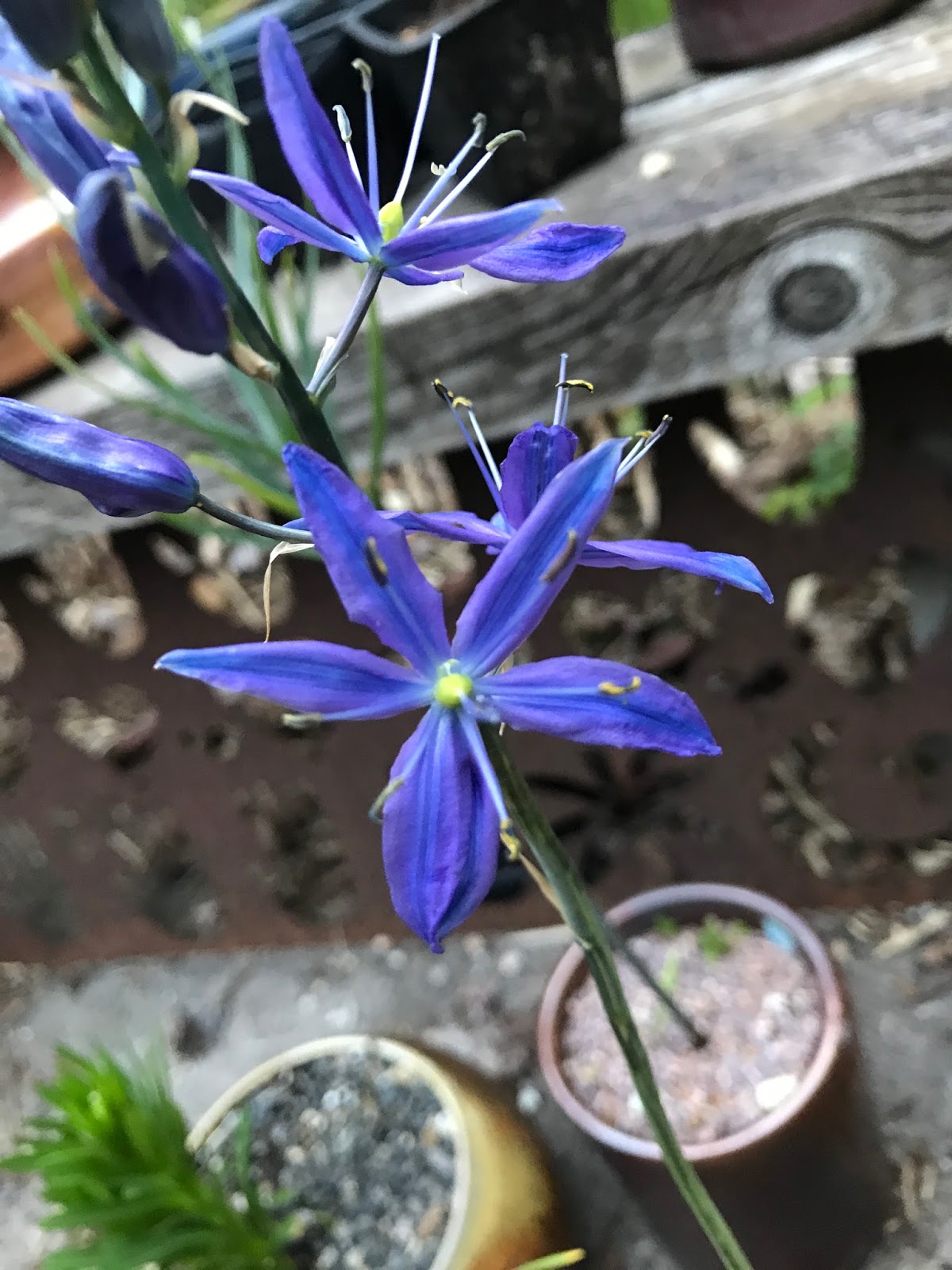
About 10 years ago, my friend Janet and I visited a stand of wild camas- Camassia quamash.  It is a native bulb in the lily family that was a food staple for North American native people.  I ate one once- raw.  It tasted like creamy dirt.  I wonder if I could sometime get an indigenous person to show me how you are supposed to cook them...

Wow.  I'm rambling this evening.  Allow me to get back to the point...

We found a camas with light blue flowers.  The petals had darker centers, and lighter color on the margins.  I collected the plant, since it was an interesting variant.  It wasn't particularly striking, but it was a cool flower.

A couple of years ago, I bought a pink-flowered Camassia leichtlinii (a larger species) from a vendor at a plant sale.  He had found it while plant-hunting, and had propagated loads of them to sell.

Three years ago, I decided to try crossing the pink-flowered one with my odd, light-blue form. Of course my light blue form died right after setting seed.  Damn it.

I've been waiting to see the flowers of the offspring until this week.  I have half a dozen plants, and one of them bloomed this year.


So far, the results aren't exactly jaw-dropping.  It could be my imagination, but I think I see some possibility in this line of breeding, however.  As the other plants start blooming next year, I will cross them.  In such crosses, the F2 hybrids are when you start to see variation.  My eventual goal would be bi-colored flowers.  I would like to see pink on the outside margins of the petals with a blue streak down the middle.  You can see a subtle version of that in these flowers.  A few generations of breeding might make that really pop out.

At any rate, projects like this give me something to work on during times when I can't find any new mutations.

Monday, April 24, 2017

The Return of the Light

It has been a long, wet winter.

We had repeated ice storms, and wind strong enough to tear shingles off my roof.  I have had a rough time of it this year.  I tend to have trouble getting through the last few months of the winter anyway, and this year's crappy events- from the election of an idiot to the death of my father- have made getting through it all the more arduous.  

Spring has come late.  While looking at photographs of my garden in years past, I have noticed how delayed the season is.  For example, my asian pear was in full bloom on March 21st a few years ago.  This year, it didn't reach full bloom until mid-April.  

I have probably never been so glad to see the spring flowers come up in my garden.  As the days grow longer and I spend more time out in the garden, it is almost like I can feel life flowing back into my body.  

Even though it is still almost as rainy as it is in the middle of the winter, I adore the longer daylight hours.  My drive home from work is through a river canyon which is shady and dark in the winter.  One day I counted ten waterfalls on my drive home, however. 

Last week, as I was driving through the river canyon, a flash of yellow jumped out at me from the cliff beside the road.  It looked quite similar to the bright yellow foliage of various landscaping shrubs around town, so I didn't really  notice it at first.  At some point over the next few days, I realized that it was growing out of the side of the cliff- not near anyone's yard or garden.

Today I stopped.  


It is a Philadelphus lewisii- our native mock orange.  As a kid, this was one of my favorite plants; its heavy, sweet fragrance was bewitching.  (Oh fuck- I used one of those words that fluffy garden writers use.  I fucking hate that style of writing.  Gross.)  

While there are plenty of cultivars of the Eurasian species of Philadelphus, there are not many of our native species.  I'm cautiously optimistic about this plant.  The foliage is luminous- it grabs your attention from the side of the road.  There is always the chance that the plant is sick, however.  I don't remember seeing herbicides being sprayed on that road, but I may have failed to notice.  Sometimes I've seen plants develop a sickly yellow color after they've survived 

This plants looks pretty healthy, however.  


I took cuttings and stuck them this evening.  If it takes, I may name it something cheesy but fitting, such as 'Return of Light'.

Wish me luck.

Friday, December 30, 2016

Dad

I lost my dad in November.

I wasn't going to post anything about this tree, since I may have trespassed in order to propagate it.  I named it after him, however, so I feel like I should post it now.

When I was a kid, I remember riding by this tree on the school bus.  I remember seeing it in the 90s and wondering if someone could graft it.  This was long before I knew how to propagate conifers, so I didn't try.

I had largely forgotten about the tree until Dad told me about it about 10 years ago.  He and a friend had some car trouble right by the tree, and they noticed its unusual form.


It is a Western Larch, Larix occidentalis, of which there are only a couple of cultivars.  That winter, I got some scions and grafted it up.  Only one took, and it has been growing in my garden ever since. While the original is maybe 20 feet high, the one here is only about three feet high.  Last year the beavers felled a poplar onto it, breaking the leader.  I was able to train up a new leader, so it is still fine (if  a bit ugly at the moment.)

I named it after Dad because we both had a love of trees- conifers in particular.

I remember when I was six, Dad and I went for a walk in the woods behind our house.  I remember telling him that I had a favorite tree, and that I wanted to show it to him.  He told me that he already knew which one it was.  He was right- it was a Pinus monticola that lived behind our house in the woods.  The species had been severely impacted by the accidental introduction of White Pine Blister Rust in the first half of the 20th century.  Dad and I both had a love for that species. They are handsome trees- usually very straight with evenly spaced terraces of branches.  The needles are soft and blue, and the fragrance of the foliage and sap is pleasing.  On the property where I grew up, there were survivors of the plague.  Dad always spoke of them with a special reverence.

During the past 25 years, we planted thousands of tree seedlings on our property- many of which were Pinus monticola.  Because the species was once very commercially valuable for window and door frames, there were significant efforts made to breed disease-resistant strains.  The seedlings we planted were from those strains.  It is fun to watch the species re-establish itself in the forests on our property.

I wasn't able to help Dad plant seedlings during the past two years.  He continued to plant thousands- even in his 80s.  His commitment to the land and the future was strong, even though he knew he wouldn't' be around to see it.

Dad was always a source of strength and support for me.  He encouraged me through my career troubles in the past several years, and went with me on several ridiculous plant outings.

Things have been difficult since his passing.  I often find myself thinking about the time we got stuck in the snow a few years back.  I was scared and didn't know what to do.  I clearly remember him saying, "Well, we just have to keep digging" as he worked to get the truck unstuck.  I will never forget his calm and pragmatic attitude in the face of a very serious situation.  I will miss his wisdom and perspective.

Dad was a kid during the Great Depression.  His father had abandoned the family when he was young, and Dad went to work in a sawmill at 15 to help support the family.  His work ethic was legendary- they just don't make people like that anymore.  In the weeks since his passing, I've heard from many of his friends and acquaintances.  Everyone talks about what a crazy hard worker his was- and about his willingness to help other people out.

Growing up, I was raised to believe that you just helped people when they needed it.  If your neighbors needed help putting up hay or doing some work on their house- you just went and helped them.  In the future, they would do the same for you.  I feel that we are losing those values and social structures.  In remembrance of my dad, I would like to help keep those values alive.  I plan to volunteer more, and to help my neighbors and friends with more projects and work around their places.

The other way in which I want to further my Dad's legacy is by propagating this larch.  If you are a conifer person and are interested in scions, please let me know.  I want to share this tree far and wide to honor Dad's memory.

I expect it to slowly make its way out into the conifer trade.  Keep an eye out for Larix occidentalis 'Ray Griffith'.