Thursday, May 11, 2017

Raw Materials

Sometimes, I find a mutation that isn't spectacular.  Normally, I might collect a cutting and just see how it does in the garden.  I may just let it grow there as an oddity.

Well, to be honest, it isn't like I am commercially producing these plants.  I have shared a few of them- but mostly, they just sit in my garden.  I have fantasized about starting a nursery, filled with odd forms of native plants- probably after I retire.  I don't know if such an enterprise would be very lucrative, but it might give me something to do when I'm an old man.

In the meantime, I just do this for fun.  I share my findings with friends and other plant geeks.  My understanding of the patent laws with plants is that you can't patent something you found in the wild.  If you spent effort breeding it, or it is a mutation you find among your cultivated plants, however, it is possible to patent the clone and make money from it.  Doing that doesn't seem likely to be worth the effort, unless you develop something really fucking amazing.

I have a few plant breeding projects going.  Hopefully, one will produce something spectacular in the future.  Mostly, I just want the satisfaction of making something spectacular.  it would be cool to see something in other people's gardens- people I don't even know- and be able to say, "oh yeah- that's my plant."

About 10 years ago, my friend Janet and I visited a stand of wild camas- Camassia quamash.  It is a native bulb in the lily family that was a food staple for North American native people.  I ate one once- raw.  It tasted like creamy dirt.  I wonder if I could sometime get an indigenous person to show me how you are supposed to cook them...

Wow.  I'm rambling this evening.  Allow me to get back to the point...

We found a camas with light blue flowers.  The petals had darker centers, and lighter color on the margins.  I collected the plant, since it was an interesting variant.  It wasn't particularly striking, but it was a cool flower.

A couple of years ago, I bought a pink-flowered Camassia leichtlinii (a larger species) from a vendor at a plant sale.  He had found it while plant-hunting, and had propagated loads of them to sell.

Three years ago, I decided to try crossing the pink-flowered one with my odd, light-blue form. Of course my light blue form died right after setting seed.  Damn it.

I've been waiting to see the flowers of the offspring until this week.  I have half a dozen plants, and one of them bloomed this year.
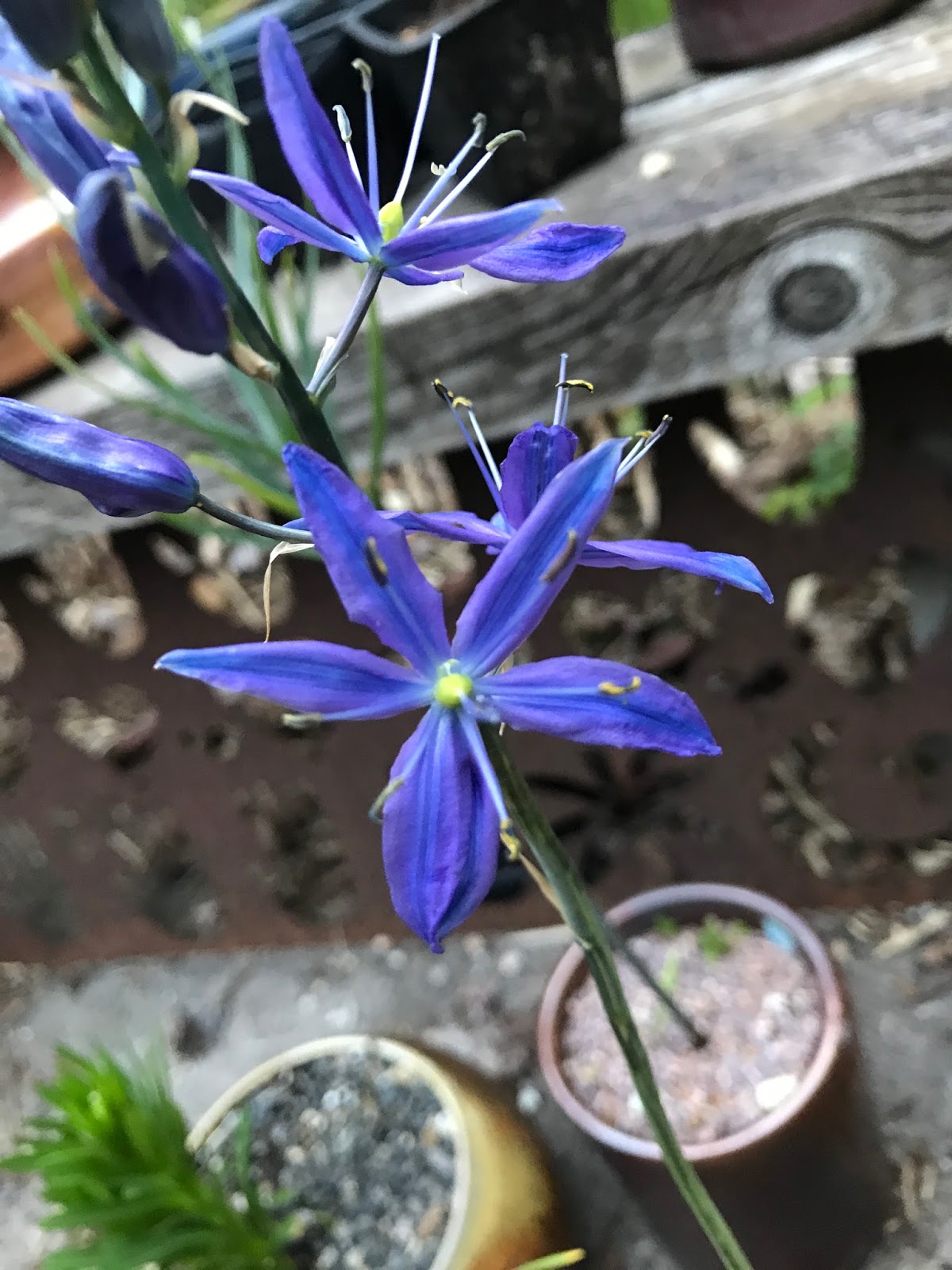

So far, the results aren't exactly jaw-dropping.  It could be my imagination, but I think I see some possibility in this line of breeding, however.  As the other plants start blooming next year, I will cross them.  In such crosses, the F2 hybrids are when you start to see variation.  My eventual goal would be bi-colored flowers.  I would like to see pink on the outside margins of the petals with a blue streak down the middle.  You can see a subtle version of that in these flowers.  A few generations of breeding might make that really pop out.

At any rate, projects like this give me something to work on during times when I can't find any new mutations.

Monday, April 24, 2017

The Return of the Light

It has been a long, wet winter.

We had repeated ice storms, and wind strong enough to tear shingles off my roof.  I have had a rough time of it this year.  I tend to have trouble getting through the last few months of the winter anyway, and this year's crappy events- from the election of an idiot to the death of my father- have made getting through it all the more arduous.  

Spring has come late.  While looking at photographs of my garden in years past, I have noticed how delayed the season is.  For example, my asian pear was in full bloom on March 21st a few years ago.  This year, it didn't reach full bloom until mid-April.  

I have probably never been so glad to see the spring flowers come up in my garden.  As the days grow longer and I spend more time out in the garden, it is almost like I can feel life flowing back into my body.  

Even though it is still almost as rainy as it is in the middle of the winter, I adore the longer daylight hours.  My drive home from work is through a river canyon which is shady and dark in the winter.  One day I counted ten waterfalls on my drive home, however. 

Last week, as I was driving through the river canyon, a flash of yellow jumped out at me from the cliff beside the road.  It looked quite similar to the bright yellow foliage of various landscaping shrubs around town, so I didn't really  notice it at first.  At some point over the next few days, I realized that it was growing out of the side of the cliff- not near anyone's yard or garden.

Today I stopped.  


It is a Philadelphus lewisii- our native mock orange.  As a kid, this was one of my favorite plants; its heavy, sweet fragrance was bewitching.  (Oh fuck- I used one of those words that fluffy garden writers use.  I fucking hate that style of writing.  Gross.)  

While there are plenty of cultivars of the Eurasian species of Philadelphus, there are not many of our native species.  I'm cautiously optimistic about this plant.  The foliage is luminous- it grabs your attention from the side of the road.  There is always the chance that the plant is sick, however.  I don't remember seeing herbicides being sprayed on that road, but I may have failed to notice.  Sometimes I've seen plants develop a sickly yellow color after they've survived 

This plants looks pretty healthy, however.  


I took cuttings and stuck them this evening.  If it takes, I may name it something cheesy but fitting, such as 'Return of Light'.

Wish me luck.

Friday, December 30, 2016

Dad

I lost my dad in November.

I wasn't going to post anything about this tree, since I may have trespassed in order to propagate it.  I named it after him, however, so I feel like I should post it now.

When I was a kid, I remember riding by this tree on the school bus.  I remember seeing it in the 90s and wondering if someone could graft it.  This was long before I knew how to propagate conifers, so I didn't try.

I had largely forgotten about the tree until Dad told me about it about 10 years ago.  He and a friend had some car trouble right by the tree, and they noticed its unusual form.


It is a Western Larch, Larix occidentalis, of which there are only a couple of cultivars.  That winter, I got some scions and grafted it up.  Only one took, and it has been growing in my garden ever since. While the original is maybe 20 feet high, the one here is only about three feet high.  Last year the beavers felled a poplar onto it, breaking the leader.  I was able to train up a new leader, so it is still fine (if  a bit ugly at the moment.)

I named it after Dad because we both had a love of trees- conifers in particular.

I remember when I was six, Dad and I went for a walk in the woods behind our house.  I remember telling him that I had a favorite tree, and that I wanted to show it to him.  He told me that he already knew which one it was.  He was right- it was a Pinus monticola that lived behind our house in the woods.  The species had been severely impacted by the accidental introduction of White Pine Blister Rust in the first half of the 20th century.  Dad and I both had a love for that species. They are handsome trees- usually very straight with evenly spaced terraces of branches.  The needles are soft and blue, and the fragrance of the foliage and sap is pleasing.  On the property where I grew up, there were survivors of the plague.  Dad always spoke of them with a special reverence.

During the past 25 years, we planted thousands of tree seedlings on our property- many of which were Pinus monticola.  Because the species was once very commercially valuable for window and door frames, there were significant efforts made to breed disease-resistant strains.  The seedlings we planted were from those strains.  It is fun to watch the species re-establish itself in the forests on our property.

I wasn't able to help Dad plant seedlings during the past two years.  He continued to plant thousands- even in his 80s.  His commitment to the land and the future was strong, even though he knew he wouldn't' be around to see it.

Dad was always a source of strength and support for me.  He encouraged me through my career troubles in the past several years, and went with me on several ridiculous plant outings.

Things have been difficult since his passing.  I often find myself thinking about the time we got stuck in the snow a few years back.  I was scared and didn't know what to do.  I clearly remember him saying, "Well, we just have to keep digging" as he worked to get the truck unstuck.  I will never forget his calm and pragmatic attitude in the face of a very serious situation.  I will miss his wisdom and perspective.

Dad was a kid during the Great Depression.  His father had abandoned the family when he was young, and Dad went to work in a sawmill at 15 to help support the family.  His work ethic was legendary- they just don't make people like that anymore.  In the weeks since his passing, I've heard from many of his friends and acquaintances.  Everyone talks about what a crazy hard worker his was- and about his willingness to help other people out.

Growing up, I was raised to believe that you just helped people when they needed it.  If your neighbors needed help putting up hay or doing some work on their house- you just went and helped them.  In the future, they would do the same for you.  I feel that we are losing those values and social structures.  In remembrance of my dad, I would like to help keep those values alive.  I plan to volunteer more, and to help my neighbors and friends with more projects and work around their places.

The other way in which I want to further my Dad's legacy is by propagating this larch.  If you are a conifer person and are interested in scions, please let me know.  I want to share this tree far and wide to honor Dad's memory.

I expect it to slowly make its way out into the conifer trade.  Keep an eye out for Larix occidentalis 'Ray Griffith'.


Tuesday, October 4, 2016

Pending Variegation


     This summer, I happened to notice a single variegated leaf on one of the witch hazels in my garden.  The plant is Hammamelis X intermedia 'Diane', a hybrid with orange flowers.  


     It is odd to see a single variegated leaf like this.  Is it a virus?  If so, why hasn't it spread to other parts of the plant?  Is it a mutation?  If so, was it just the leaf that mutated- or is the auxiliary bud above the leaf also mutated?

     I've had similar mutations in my garden before, only to find that they burn in the sun, or are not stable.  My hope with this one is tempered with experience.  Next spring, I will prune that branch to the bud above that leaf, in the hopes that the variegation will continue.  As I'm typing this, I realize that I need to mark that bud so that I remember which one it is.  When the plant loses its leaves this fall, they will all look the same.


     I imagine a whole bush with leaves like this.  The pattern looks almost like an aerial photograph- with fields and forests.  I might have to name it something that pertains to maps- if it turns out to be a keeper, that is.   

Wednesday, September 7, 2016

Getting Hit With the Different Stick

I once worked with a student who had a whole stack of unusual health issues.  I'd list them, but they are so unique that I should keep my mouth shut about them for the sake of confidentiality.

I used to say that he got hit with "the different stick"- a play on the expression to get "hit with the ugly stick".   It wasn't meant in a negative way...  I was just amazed at the chances of being that different in that many ways.  I've often felt that way, myself.

A former coworker once visited my garden, and I pointed out a raspberry sport that I had found with gold foliage.  "How did you even see that?" he asked.  He said that he would have assumed it was sick and pulled it out.  He then went on to observe our respective attitudes toward students with cognitive differences.  He said that he was more like to look at what was "wrong" with a student- whereas I was more likely to think, "what a wonderful mutation!"

I think he was on to something.

I was hit with the different stick a few times, myself.  This summer, I've been dealing with a mutation that I have.  I figured Id talk about that this time :)

This is a picture of my fouth great grandmother.  Notice her left eye.  The condition is known as ptosis.  It has a few different causes.  I don't know if hers is the same as mine or not.  I have another female ancestor on the other side of my family who had the same issue.  I don't recall if it was in the other eye or not :)

I have ptosis in both eyelids.  Mine was caused by the my eyelid muscles failing to develop when I was a baby.

When I was a kid, I was able to raise my eyelids by raising my eyelids.  You can't get them very far open that way, so I always had very droopy eyelids.  When I was 14, I had surgery to correct it.  The doctor used silicone slings to tie my eyelids up to my eyebrow muscles.  I can raise my lids by raising my eyebrows.  It still doesn't look all that natural, but I have a much larger field of vision.

Over the past few years, the sling in my left eye failed.  I couldn't open that eye very far, and my peripheral vision was getting pretty restricted.  I finally mentioned it to the doctor, and I was scheduled for surgery to repair it.

The procedure was performed while I was conscious, but sedated.  I can't say it was pleasant :)


The doctor made an incision across my eyelid, and then stitched the silicone band to the tarsis (the firmer, inside tissue of the eyelid).  Then, he used HUGE needles to thread the silicone under the skin to the small incisions above my eyebrow.  The doctor actually complained about how dull the needles were several times.  At one point, they had to increase the tranquilizer they were giving me, because it started to hurt a lot.

It healed up fairly quickly, and it looks better than the other eyelid does.  I almost want the right one to fail so I can have him redo it :)


Saturday, August 20, 2016

Another Douglas Fir Broom


This summer has been a crazy one.  As is too often the case, I haven't made it out into the wilds much.  I have been working on my house- which really needed some maintenance.

In the meantime, I thought I'd share some pictures of a Douglas fir broom that I found several years ago.  It would take another crazy snowmobile trip to get scions in the winter, and I'm not sure I'm up for that.  Maybe I will try an autumn graft of it one of these years.  It is kind of cute, and seems to be worth propagating.  


I think I've said this before, but it seems that this species- Pseudotsuga menziesii- seems to throw brooms much more often than other species.  This is true of both the coastal variety- var menziesii, and the interior form- var glauca (which is what this broom is).  I have to wonder if the other species in Southern California and in Asia are prone to brooms as well.  


The new groth looks kind of nice.  


Wednesday, April 13, 2016

I'm Still Alive

Wow.  It has been nearly a year since I have written a new post.  How do our lives get so busy?

I haven't done as much plant hunting as I would like.  During the past year, I worked a LOT.

Even so, I have found a few things.

Tonight, I was walking through a park in Portland, and I came across this broom in an incense cedar- Calocedrus decurans.  Much of it was dead- which frequently happens to brooms that are lower on the tree.  If it were propagated and given good care, I have to wonder what it would look like.  I'm guessing it would be a fastigiate form that might make a good tree for commercial landscaping purposes.

There is only one way to find out :)