Wednesday, May 15, 2013

Bladderworts


We have a number of carnivorous plants that are native to the Northwest, but most people don't ever see them in the wild.  To do so, you have to locate specific types of wetlands and then go get your feet dirty.  Many of these wetlands were drained for farmland in years past, so we are left with a few bogs and fens that are either too remote or persistently soggy for farmers to have destroyed them.

A number of years ago, I read an article in the International Carnivorous Plant Society's newsletter by Hawkeye Rondeau.  In the article, he described his searches for a rare species of bladderwort called Utricularia ochraleuca.  I was intrigued by the idea of undocumented populations of native plants, and I determined to begin my own searches.

Through my contacts at the botanical garden where I worked, I learned the locations of a number of bogs in the Cascade mountains of Oregon and Washington.  When I first began to explore the bogs and fens, I remember being a plant frenzy that would leave me utterly exhausted by the end of the day.  I soon expanded my search to North Idaho and adjacent counties in Washington, where yet more botanical discoveries were to be found. 

In case you aren't familiar with wetland terminology, a fen is a wetland that has water seeping through it from underground.  They typically have a creek that emerges somewhere in the bog and flows out the lowest point.

A bog, on the other hand, only gets its water that falls into as rain and snow.  

Nearly all the peat wetlands that I've visited in the Northwest are fens.  No two bogs or fens are alike.  Most of this depends on the nutrient content of the soils and water.  In higher nutrient bogs, grasses and shrubs dominate.  Carnivorous plants are less common or absent.  

In the  most nutrient-poor sites, like the one in this picture, plants that are well-adapted to low-nutrient environments abound.  This is where you find the most carnivorous plants, such as the sundews, Drosera anglica.  The taller white flowers in this picture are false asphodels, Tofieldia glutinosa (not carnivorous.).


When I first went to this bog, I was blown away by the sheer size of the sundew population.  I once estimated that there were upwards of 44 million individual sundews.  Somewhere out there, there must be a variegated one, but I've never seen it.

The ground is red with them, and, on sunny days, there is an insect holocaust underway.  Damselfies, craneflies, and butterflies are struggling against their inevitable deaths in all directions.  If the wind is quiet, you can hear the desperate sounds of their efforts.  It is kind of disgusting, actually.


Each rivulet that drains the fen is filled with the foliage of bladderworts.  Utricularia minor- the lesser bladderwort- is found in many of the deeper creeks.  (By deep I mean several inches)  The shallower streams are filled with Utricularia intermedia, a more robust species.  In late June, their yellow flowers can be seen across the soggy landscape.  

One afternoon, while my friend Janet and I were exploring a stand of lodgepole pine trees in the middle of the fen, we found a plant that looked very similar to Utricularia intermedia- but that had red foliage.  This photo is not the best (I am not a photographer), but you can see the red foliage in the water.  The upturned yellow flowers that are standing on stems several inches above the water belong to the bladderwort as well.  

Here is a closeup of one of the flowers.  Though the plant looks almost exactly like Utricularia intermedia, the short spur (on the lower side of the flower) indicates that it is actually U. ochraleuca.  


This species had not yet been documented from this location, so I'm pretty sure that we were its discoverers.  Fun stuff :)


And now for a gratuitous picture of one of the orchids that grows in the bog, Plantanthera dilatata.   This species is powerfully fragrant.  On a warm day, you can smell the flowers from several feet away.  It grows in slightly elevated parts of the bogs among grasses.


If you aren't afraid of getting your feet wet or muddy, I highly recommend checking out any bogs you might have in your area.  The plant species can be really fascinating.  I love returning to this bog every year- both in the spring to enjoy the flowers and foliage of the carnivorous plants, and in the fall to pick the cranberries.


Wednesday, May 8, 2013

There's a noble fir growing out of my lodgepole pine!

"Mike says that there is a noble fir branch growing out of his lodgepole pine," my dad said.

That was obviously impossible.  It did sound like some kind of mutation that I should check out, however.  I told Dad that I'd be very interested in checking it out.

The following day, he told me that Mike would be leaving his place at 8, so we needed to be there at 7:30 in the morning to meet him.  My dad is a morning person extraordinaire, so he got me up at some ungodly hour- I don't remember exactly when.  We ended up leaving very early and showing up at Mike's place at about 7:00.  It wasn't even light out.  

We walked out into the lodgepole woods away from Mike's place a hundred yards or so, accompanied by the sound of the barking huskies back at the house.  There was maybe a foot of snow on the ground, and it was in the mid-20s.  Such temperatures are typical in northeastern Washington in December.  

Mike found the tree and showed us his "noble fir" branch.  It was a flat broom, dangling from a spindly and weighted-down branch near the bottom of the tree.  Such a broom is a welcome change from the usual fall-to-your-death locations of most brooms.  I wouldn't need climbing equipment or a shotgun to get pieces of this one.


The needles of the broom were less than half the length of normal lodgepole needles.  Most of the foliage in the center of the broom was dead- presumably from being shaded out.  Most branches this low in the canopy die, so the tree can put more energy into branches above that have access to more light.  In a few more years, this broom may die completely.

I did not have many rootstocks left of this species this year.  The ones I had were slightly too small (the diameter of the scion should never be larger than the diameter of the stem of your rootstock.)  I took a few scions anyway, just to give it a try.  I could always go back next year and get more if it didn't work.

As I write this, most of the grafts don't look so good.  I am holding out hope for two of them.  I am getting some new stocks ready for next year.

I have to appreciate people like Mike.  He may not have experience with grafting, dwarf conifers, or broom hunting, but he is observant of the world around him and noticed something  unusual in one of the trees near his house.

If you continue to read this blog, you will come to see that these mutations are all around us.  All it takes is the willingness to look for them.

Wednesday, May 1, 2013

Come Away, Oh Human Child

William Butler Yeats wrote a poem called "The Stolen Child" in which fairies are running around kidnapping children, pestering trout, and stealing cherries.  Loreena McKennit set it to music, and it is quite nice.

The bit about the trout is especially compelling in my book.  The fairies lean out over streams and whisper in their ears to give them "unquiet dreams."  I love that.  Unquiet dreams.

In the Northwest, we call our Erythronium species Trout Lilies, due to the brown markings on their leaves.  They are all quite enchanting- tiny and delicate... fading with the first warm days of summer.  I've been collecting seed and starting them in my garden for a few years.  In time, I hope to have drifts of them to light up my garden in the earliest days of spring.

My friend Janet and I were exploring a couple of populations of one of the Oregon species- Erythronium revolutum.  It is one of the few species that has pink flowers (most of the rest have yellow or white petals), and it has particularly nice brown stripes on the leaves.  During the course of this particular early April day, we looked at thousands upon thousands of them.  There were larger plants with two blossoms per stem- all the way down to first year seedlings that look like baby onions.  They grew by the bazillion in both locations.  Absolutely betwitching.

Oh god.  I'm starting to use garden writer terms- bewitching- enchanting.  The next thing you know, I'll be using alliterative strings of adjectives that make cheese-sensitive readers want to puke.

But it is true...  they are magical little things.  We made plans to head back in the summer to see if we could collect seed.  Tragically, the second population was in a grassy area by a highway, where a lawnmower would destroy the flower stalks before the seed would mature.  There were a few areas among the shrubs that would still be ok, however.

"You know, Janet, I bet somewhere in the middle of these thousands of Erythroniums, there has to be one that is variegated.  Could you imagine the variegation running underneath the brown marks?"

She agreed that this would be spectactular- if a bit far-fetched.

I shit you not.  About five minutes later, as she was taking pictures of some of the largest specimens a few yards away, I looked down.  This was right in front of my feet.  Seriously.


A young plant- maybe only 3 years old or so- was there, showing off its bright yellow variegation.

"Janet.  Come here and look at this."

She kept taking photos.

"Seriously, you need to come look at this."

We both stared at it for moment.

Janet handed me the trowel.  I pushed it into the ground, slicing out a cylinder of soil about three inches in diameter and six inches in height.

I found a nearby discarded softdrink cup and put the precious cylinder of soil in it.

About half-way home, we stopped for snacks at a convenience store.  I looked in the back seat at my treasure.  It was wilting.  I carefully watered it and worried.

I got it home and plunged the cylinder of soil into one of the best beds in my garden.  I placed a clear glass bowl over the plant to limit moisture loss- and shaded it with a piece of corrugated plastic to keep off the sunlight.  (That would have cooked it.)  Even with that treatment, the single leaf of the Erythronium wilted and died a couple of weeks later.

I spent the next year wringing my hands and hovering over that cylinder of soil.  When spring came, the other, typical Erythronium next to it in the cylinder of soil came up and produced a nice, healthy leaf.  I was heartbroken and wracked with guilt for killing this special specimen.  (Yep.  There's that alliteration- grab your barf bags!)

Two weeks later, I was overjoyed to see a lemon-yellow spike of foliage poke through the soil.  The variegated Trout Lily had survived the collection process.


It will be years before you see it on the market- and indeed, you can't really tell how cool it is going to be from that picture.  I have a good feeling about that plant, though.  Great things are in its future.  I decided that I will eventually name it Erythronium revolutum 'Unquiet Dreams', aftter the Yeats poem.  Worrying about whether it had survived gave me plenty of unquiet dreams...  plus, it is a Trout Lily of an otherworldy quality. If there were fairies, I am sure that they would be whispering to this delicate little ephemeral flower.

Wednesday, April 24, 2013

Frozen Wonder


 Determined to start more Larix lyallii trees for experimentation, I headed back up to North Idaho in the fall of 2007.  I had already found a tree that was covered in cones, so I tried to time my trip to catch the seeds before they fell out of the cones.

That fall, I called the ranger station in Bonner's Ferry to obtain a permit to collect the seeds.  The ranger actually laughed when I told him that I wanted to collect a few hundred seeds.  "Just take them," he said.

I took a Friday off work and spent a long weekend traveling to North Idaho and back.  I'd never been up there that late in the year, so I wasn't sure what to expect.

Here's what greeted me on the trail on the way in:


The track is from black bear and the leaf had fallen from the huckleberry bushes that cover the landscape.  There was only a half-inch of snow, so driving up there wasn't really a problem.   Though the bears were obviously not hibernating yet, I didn't see any large game animals on my hike.


The tree that I'd previously located was a couple of miles in- perched on the edge of a 1000 foot cliff.  I collected dozens of cones that were at the perfect stage.  They were ripe, but had not yet released their seeds.

Once I was back home, I tried germinating some of them, but I was met with failure.  Larix lyallii isn't an easy species to propagate from seed.  I must have just been lucky that first time.  I donated seed to the seed exchange of a local botanical garden, in the hopes of giving growers in other countries access to this uncommon species.  I have to wonder if they had any better luck than I did.

Larch trees tend to have only a couple of decent cone crops per decade- if that.  I am not sure when I'll next be up there at the right time on a good year.  I kick myself for killing that tiny seedling that I had so painstakingly raised for four years.


This blog seems to be turning into an obituary for plants that I've killed.  Depressing.

Wednesday, April 17, 2013

Hemispheral Displacement


In the Pacific Northwest, most people (at least those of us who have spent time on the east side of the mountains) are familiar with the western Larch- Larix occidentalis.  In the fall, its deciduous needles turn bright yellow and put on a pretty good show, particularly when they are peppered out through their evergreen neighbors.

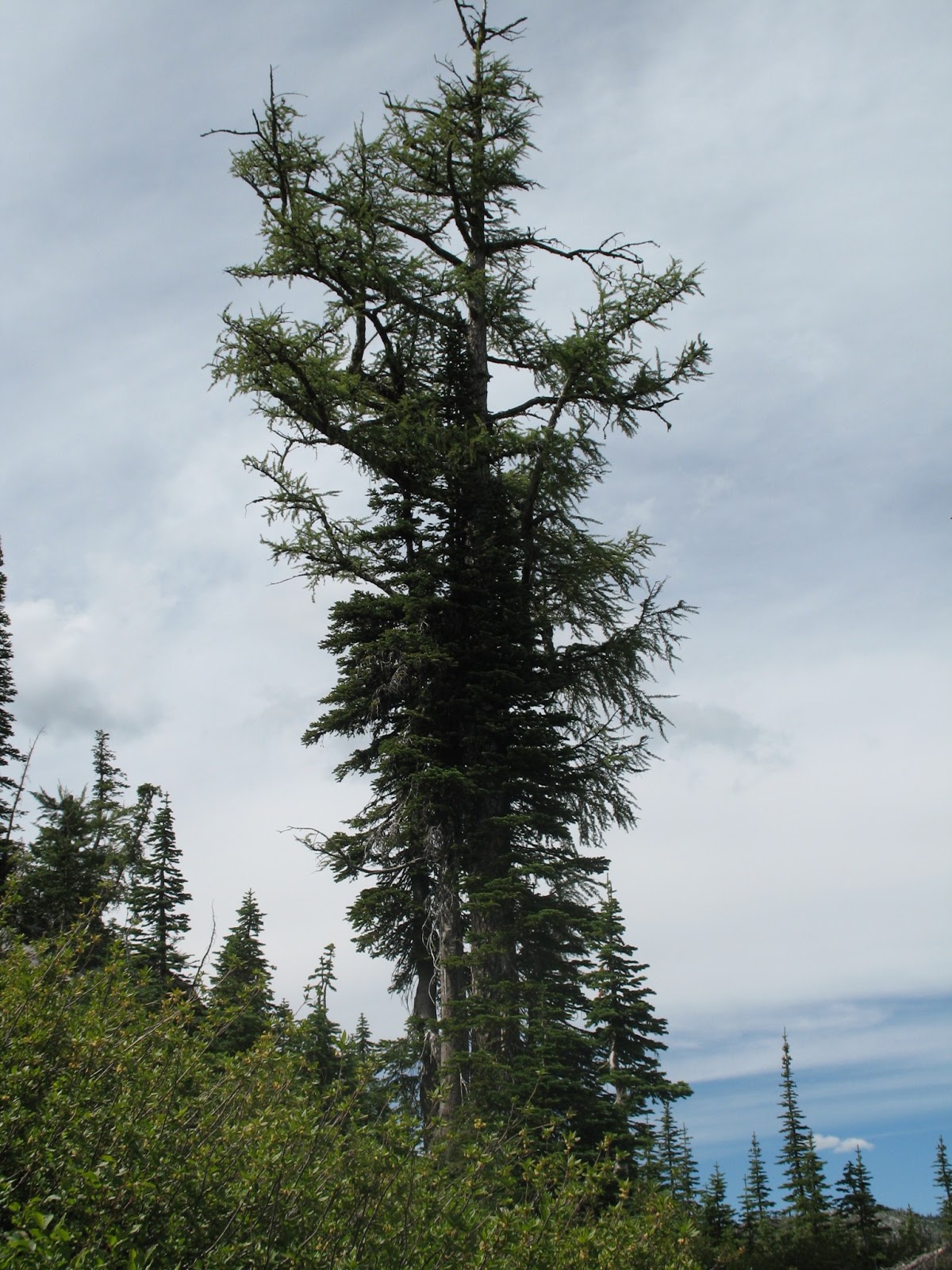
We actually have another species of larch as well, though most people don't venture into its remote habitat.  It is the subalpine larch- Larix lyallii.  You are not likely to see this plant grown in gardens, since it seems to detest our warm summers.  Mind you, our summers are very cool compared to those in most other parts of North America.  I have never seen this plant in cultivation.

 The picture to the right is of a very large specimen in North Idaho.  It isn't that big when compared to western larches, but for a Larix lyallii, this one is pretty big.

About ten years ago, my dad and I visited a small population of them in the northern part of the Idaho Panhandle.  In the picture below, the larches are on the far wall of the cirque basin (you can't see any of them clearly- I just wanted to give you a picture of how rugged and cold their habitat tends to be.)


In the little copse of larches you see on the far shore of the lake, I was able to collect a few cones that had fallen to the ground.  They still had a few seeds in them, which I took home and treated with hydrogen peroxide for 24 hours.  I got one to sprout.

My idea was to try growing this tree as a bonsai indoors under lights.  Its growing season would be during the winter months, when keeping it cool would be easy.  During the summer months, it would spend its dormancy in the refrigerator.

The tiny seedling was very spindly for its first year.  at one point, I dropped the pot and the gravelly potting medium spilled out across the floor.  I was sure that I'd killed it- but it didn't seem to be too disturbed.

When spring rolled around, I began to reduce the day-length from the lights.  After a couple of weeks of 10 hour photo-periods, I put it in the refrigerator along with a compact fluorescent bulb on a table lamp.  I gave it 8 hours of light per day for a few weeks and then took the light out.

The next October, it started to come out of dormancy on its own.  I was always amazed by this, since it had no access to light, and the temperature was presumably held very constant by the fridge.  In my reading, I had learned that dormancy is induced in larches by shortened days in the fall.  It is broken by rising temperatures in spring.  (Alas...  I have absolutely no idea where I read that, so I'm just going to be a guilty, plagiarizing fucker here)  Is there another process involved?  Is there some tiny metabolic timer that just counts out the hours, regardless of temperature?  External cues from the environment wouldn't likely have penetrated the fridge...  plus the season was off by 6 months, so it wouldn't have been getting correct signals to break dormancy in October.

Anyhow, here is what the plant looked like after 4 years or so:


That year, I was really busy, and wasn't able to go through the full routine of inducing dormancy.  I just stuffed it in the refrigerator.

That doesn't work.  It just killed it.  God damn it.  I think that this would be a viable- if high maintenance- method for growing this plant.  It would have made a very nice bonsai, and I may well have had the only one in the world growing on Southern Hemisphere schedule!

That same year, I had actually gone back to North Idaho to collect more seed.  I will show some pictures and tell the tale next week.

Wednesday, April 10, 2013

A Mutant May Not Be Weird Enough...

During the summers, I am sometimes able to talk my dad into driving around on forest service roads while I sit in the back of his truck, looking for brooms and other mutants.  This has proved to be productive sometimes.  On other days, I get a sore butt from the bumps for no good reason.

A few years ago, on such a trip, I happened to see this little scene.

The trouble with some of these trees is that there is no way to get a good picture of them- there are just too many trees around them and there is no good angle.  

The tree in the center is a weeping Douglas fir.  It is actually a fairly graceful form that would be worth propagating.  Maybe someday I will make it back there during the right time of year.  However, there are already a number of weeping Douglas firs out on the market.  Getting to some of these trees in the winter (the best time to take scions) can be tough.  This one is remote enough that I may not ever get around to it.

In future posts, you'll see the trouble that I will go to when a mutant is both remote and unique.  You'll probably think I'm a nutcase afterwards.


Wednesday, April 3, 2013

Asking Permission


Grand fir- Abies grandis.  I grew up in woods that were filled with this species.  Commonly used as a Christmas tree, this species has a handsome form and aromatic foliage.  While it does grow in coastal climates, west of the Cascade Mountains, it is most at home in the mountains of Eastern Washington and Idaho.  I believe that the Interior form is bigger and more handsome.  The ones we see on the West Side aren't very impressive by comparison.

For information on this spectactular species, check out the Forest Service's Sylvics Manual:

http://www.na.fs.fed.us/spfo/pubs/silvics_manual/table_of_contents.htm


I haven't seen many witch's brooms in Abies grandis.  I know only of two.


I noticed this broom last winter,  My dad and I were in a field, checking out a spectacularly weeping Engelmann spruce (there will be a post about that one in the future).  As we headed back to the highway, I caught site of a large, dark blob in the top of a tree about a half mile off.

When you get closer to the tree, it isn't visible from the highway.  We had to carefully look through the dense foliage of lodgepole pines.  When I originally found it, I was exhausted from the arduous journey to yet another broom in the mountains.  (again, a subject for another post)  I was too tired to deal with this one.

Last week, I was up at my dad's for a week to help plant trees and clear brush.  We drove up to the location of this broom to try to get permission to shoot pieces out of it.

In that part of Washington, brooms tend to be either on private land near the roads that you can traverse in the winter- or else up in the mountains where you need a snow mobile.  When they are private land, I always ask permission.  Typically, the owners live on the plot of land, and all it takes is stopping in to ask.  Most people are friendly and curious about what I'm doing.  (A few haven't been- that might be a subject for a post sometime.)

Dad and I drove around the perimeter of the property, looking for the owner's dwelling.  The boundaries were not very clear.  We stopped in a neighboring property, where a woman was out walking her dogs.  She asked me to wait a moment while she put the dogs inside.  They were friendly, but were making a lot of noise.

I introduced myself, mentioned the broom, and described what it was.  She said that it was not, in fact, their property, and that she thought that the place belonged to someone who lived out of town.  I gave her my name and phone number, in case she was able to find out who it was.

A few days later, Dad and I stopped by the county tax assessor's office to find the contact info for the owner.  It turns out that it was indeed owned by a person from out of town- in a different corner of Washington.  No email addresses or phone numbers were available- just a snail mail address.

Today, I mailed out a request for permission to the owner.  I have to wonder what it would be like to receive a letter like that.  Very few people in the world know what a witch's broom is, let alone that some can be propagated.  Most people in Eastern Washington will readily tell you that "that's mistletoe- you have to cut it out."  While the majority of brooms are, in fact, produced by such parasites, this one is almost assuredly not. Any time a broom looks like a neat and tidy tree that you'd want in your yard, it is pretty likely a genetic mutation.

Regardless, I think it would be weird to get random letter from someone who wanted to go onto your property and shoot your tree with a shotgun.  I hope that the guy responds.  I included a self-addressed, stamped envelope.  If it were me, I think I'd probably intend to respond, but never get around to it.  I just hope that this guy is more with-it than I am :)

Of course, there was the option of just doing it ninja-style.  I'd be willing to bet that there is no ninja-style way of shooting a tree with a shotgun, however.  The broom is high enough that it would probably take multiple shots.  If I attract attention, I would like to have written permission in hand to show the neighbors or cops.  Plus, if someone wanted to come onto my land and take cuttings from a tree- shotgun or not- I would appreciate the honesty and respect of someone asking permission beforehand.

Wish me luck!