Wednesday, July 27, 2022

Dog Shit and Tweakers

    During the first several months of the COVID-19 pandemic, I took many, many walks.  I would often cross the river on the pedestrian path on the side of the freeway.  The bridge was built a few years ago, and the walkway is nice and wide.  

    There has always been a population of homeless people living out there.  Like many people in the US, situations like these pit my sense of compassion against my need for safety.  They often stole the apples off my fruit trees.  That didn't bother me all that much, since I figured they were hungry and needed them.  One year, they stole my hammock.  I saw later in one of their camps and decided to just let them keep it.    

    There is certainly a fair amount of mental illness (I've encountered numerous people in the throes of psychosis) and drug use.  There is even a delightful (sarcasm!) amount of profane, obscene, and racist graffiti on the bridge.  The one below was accompanied by a lewd drawing.  At least it was in chalk, so it doesn't deface our new bridge.  The style of the letter S is an intentional Nazi reference that I've seen in other, more overtly racist, graffiti.  


        While everything was shut down during 2020, I had to quit going down to the bridge.  It felt unsafe to me.  People would sometimes yell at me for wearing a mask, or come up and get right in my face.  Before my vaccination, I didn't want anyone close to me.  

    Another lovely feature of those shut-down days was the amount of dog feces in the street and on the side walks.  That isn't something I'm accustomed to in North America.  It is pretty common in Latin America, where dogs run all over the place, shitting on sidewalks. I still don't know why people quit scooping up after their dogs.  It isn't pleasant to smell human and dog waste while you are out for a walk.

    In the past few years, the number of people who are homeless has exploded.  Over the past couple of weeks, I have been walking past a new camp.  My walking route takes me past their open latrine, where you can see paper towels, toilet paper, and lots of flies.  The people don't harass me or anything, so I don't feel uncomfortable with them being there.  What worries me, though, is the latrine.  Open defecation is a huge public health issue.  In countries where it is common, parasites and disease abound.  We don't have those diseases here because of our sanitation infrastructure.  But we now have a growing population living without modern sanitation.  How long will it be before those diseases become part of life here in this country?  

    I won't launch into politics here.  The actual reason for this post is to show what I found next to that camp.  There is an Oregon oak seedling that has no chlorophyll.  When the food from the acorn runs out, it will die, since it can't produce any sugars on its own.  I have seen cherry seedlings like this before.  I even tried to graft them to other seedlings without success. 


    I'm not inclined to torture this tree's short life by grafting it, Frankenstein-style, to another plant.  I have to fantasize about what an albino oak would look like though...  A tree like this would be so ghostly.  

    I will appreciate it while it lasts.  

Sunday, July 24, 2022

Mosquito Hell


This year has been a nightmare for mosquitoes in my area.  It was a really wet spring, which allowed some species of mosquito to hatch out in unprecedented numbers.  In order to go out in my garden- even in the full sun- I have to keep myself slathered in DEET.  They bite me anyway.

I've taken to walking down by the river, as I do most summers.  I can usually keep the mosquitoes at bay if I don't stop.  Today, however, I had to pee, so I had to step off the main trail into the shade.  They were all over me instantly.  God, I hate those little fuckers.

I came back out into the sunshine, where there are lots of what I take to be Clarkias.  I know they are in the family Onagraceae, at least. I suspect they were planted there with a mix of wildflower seeds, since I don't see them growing in other areas. 


For the past couple of weeks, I have been thinking of collecting seeds from these plants this fall.  they are really pretty impressive.


Today, as I was cursing and fleeing the mosquitoes, I came across this plant:


The markings on the petals are really striking.  I will definitely be collecting seed from this plant, if not cuttings.  I'm not sure if this is an annual or perennial species, so I will try both.  The variation was not quite as unique as I had first thought, however.  I found a handful of other plants with similar markings- though not quite as dramatic as these.  I doubt this is a rare mutation that is one-of-a-kind discovery, but it will be a fun plant to grow in the garden.  

Now if only those fucking mosquitoes would die...


Sunday, May 29, 2022

Close to Home

Today I was peeing in my garden (I mean...  why else would anyone have a garden- except as a a giant urinal??)


I happened to look up and saw a large double flower on my Asian pear tree.  The rest of the tree flowered almost two months ago, so this was quite a surprise.  I have no idea if it is a fluke- or a mutation that will persist if I graft it up and observe it.


If it turns out to be a good one, I can just imagine the tree covered in flowers like this.  Check out this photo from April when the whole tree flowered:


It might be incredible.  Just imagine all those flowers being double!   But as always, only time will tell!

Sunday, March 20, 2022

I hate everyone.

 I wonder if anyone still reads this.  I rage-quit Facebook about a year ago.  Best decision I ever made.  While the new meme-vectors will continue to tear our world apart and replace it with some still-unseen order, I can at least keep my brain from being force-fed garbage.


I'm always tempted to write about my love life in these posts.  Sexuality is what drives so much life on this planet.  I look for mistakes that would otherwise end up in the trash-heap of evolutionary rejects.  I am one such reject, myself.  Sometimes it sucks to think about how my ancestors reproduced without fail for the past few billion years.  And I get to be a dead-end.  Yay.


But here in my little back-water of evolutionary accidents, I have created a place for us weird rejects to live together in relative peace.  I guess.


Yesterday I was walking with my friend Bobbi, ranting as I usually do about my failed love life, the perversity of Evangelical Christianity (where they take a religion that is supposed to be based on love and make it all about hate), and work stress.

This broom was literally right in front of me as we turned a corner.


It was in someone's Norway Spruce tree, hanging over the sidewalk.  Since it was easily within reach, I took a little twig.  I will be grafting it up today.  It is a tiny broom that might make a good rock garden plant.  I'm not super excited about the species (I tend to be more excited about our native trees) but I will give it a try.


I'm not going to change my negative attitude just now.  There is too much crap in the world for me to think positively right now.  But I will stop and appreciate a cool little treasure that pops up in front of my face during the shitty times.  

Friday, December 25, 2020

Shit

A couple of months ago, a friend and I sit out to explore an area in the Oregon Cascades  it was a really long drive. For some reason, the night before, I was only able to sleep for an hour. On the trip there, I slept all the way.

When we arrived, I got out and started my legs. The elevation was pretty high, so the temperature was low. There was ice on every mud puddle, on the lakes, and in the creeks.  We hiked along the creek through mature alpine fir- Abies lasciocarpa  it was a lovely area. After a short hike, my friend sat down on a boulder to smoke her marijuana. I do not partake, so I wanted something to do while she sat there and got stoned.

I wandered off and happened to stumble across a mostly dead broom in an alpine fir  


There were a couple of twigs that were barely alive, so I took some scions for grafting.  Early November isn't ideal for grafting, but I can't see being able to get in there January or February.  
I am not going to get my hopes up, but I will be glad if one succeeds.

I used to get really frustrated when there was an interesting mutation that I couldn't collect easily.  There have been a few that I haven't had success with- either because they are inaccessible, the land owner ignored my request for access, or other reasons.  Such is life.  Sometimes it seems life is too complex and out of our control to freak out about everything that doesn't go our way.

My perspective has changed in the past few years.  It isn't that I don't get pissed off at shit.  It's just that I fight against the shit coming down less.  I guess.


Oh.  and there are pictograms there.  It was a trade route for indigenous folks, and several rock paintings are there.  They are faded, but intact.  

Friday, September 11, 2020

Stupid People

My friend Melissa and I took a long drive through the woods in Washington State the other day.  It was Labor Day weekend, and a bazillion people were out in the forest.  I found myself cursing at every vehicle that passed us on the gravel roads, kicking up lots of dust for us to breathe.

After a while, we turned off on a smaller road to go explore a bog that I know about it.  It is full of carnivorous plants and cranberries, and it is delightful at any time of year.

At one point, I happened to look out the window and saw this larch tree:


That broom looks rather promising.  We will have to go back with my shotgun to see if we can get some scions for grafting.  There aren't many cultivars of that species, so I'm kind of excited about it.

We continued south, and came across an abandoned bonfire.  Not just a little camp fire.  A fucking BONFIRE.  

What in the hell is wrong with people?  This was one day before the windstorm that is currently burning the entire west coast of North America.  OMFG.

We didn't have a bucket, so we scooped water out of the creek, using a reusable grocery bag.  It took a lot of water to extinguish the fire.  it kept boiling away as we stirred it into the coals.  We finally got it extinguished.  

Here's a pic after we dumped a lot of water on it:


The next day, the wind kicked up, and the whole West Coast caught on fire.  if we hadn't put that fire out, I'm sure the wind would have fanned that substantial coal bed, and the woods next to it would have burned. 

Melissa and I have been patting ourselves on the back all week for being such great citizens.  You are welcome, Washington!  😀


Friday, August 28, 2020

Exploding Brains


There are certain native plants that seem invasive.  Populus trichocarpa, or the black cottonwood, is one.  Its seeds fly on fluffy down in June every year, and the resulting seedlings come up by the thousands in any damp location.  They grow quickly, and produce lots of root suckers.  They can be a bit of a pest as a result.

In the past couple of months, I've gone through a bunch of personal weirdness- mostly romantic angst.  I know that's my usual subject of whining, so I won't subject you to it now.  Needless to say, it has resulted in restlessness and sleepless nights.

In order to get my shit back together, I quit drinking alcohol and I've been taking walks- sometimes up to three per day.  Sometimes my phone logs 30,000 steps in a day.  It has had a good effect on my health and mood.

One of my walking routes involves a trail through a wetland area, populated by lots of Populus (see what I did there?)  After walking the trail dozens of times, I finally looked more closely at the yellowing leaves of one cottonwood branch.

I had noticed the yellow leaves before, but they only registered as sick leaves, yellowing in the August heat.  Upon closer inspection, however, I noticed that they are variegated.  And rather nicely variegated at that


Imagine a large tree with foliage like this:


As I've discovered before, though, sometimes such variegations are unstable and quickly revert to green.  This one looks promising, so we will  see.

In the  meantime, if you never hear from me again, you will know that my brain finally exploded from romantic entanglements.  I suppose there are worse ways to die...


Friday, May 15, 2020

Wherever you go...

I haven't posted much in the past couple of years.  that's generally because I haven't been out hunting plants much- with the exception of some trips to South America, but those are the subject for a future post.

Since we are still doing the social distancing thing, I figured I should go out in the woods and hike around alone.  The trails are all closed, but nobody monitors the forest service roads.  Since I tend to walk on random roads, rather than trails and roads near attractions, I rarely encounter other people.

Today I explored an old clear cut.  My thinking is that the trees are all small- under 10 meters high- and I should be able to reach any mutations I find without using the gun.  Plus, I will see a larger mix of species that grow in the sun as well.


I didn't find any interesting mutations, but I had an enjoyable walk in the woods.  I tend to think a lot when I do that, so I reflected on my experiences both as a plant hunter, and as a human being in general.

As I have gone out plant hunting, some days I feel disappointed for not having found anything.  I sometimes worry that I picked the wrong place to look.  But upon further thought, I know that is bullshit.  The thing about hunting for plants is that interesting mutations can literally be found anywhere.   They could be in the middle of a clear cut, in someone's yard, a parking lot, or on the side of a busy freeway.

I tend to hike and explore in places that have diverse and interesting plant life.  Those places usually aren't the most popular hiking trails, which are frequented by people who value large old-growth timber, spectacular views, and waterfalls.  I enjoy those things as well, but they are not my primary focus.

What I love the most is that you can find wonders- real wonders, not consolation prizes or Pollyanna bullshit- anywhere.  The place need not be sacred, beautiful, or awe-inspiring.  I would never have found some of the plants in this blog if I had stuck with popular outdoor spots.

I traversed the clearcut, carefully looking at the trees and undergrowth.  The trees included Douglas fir (Pseudotsuga menziesii), Western Larch (Larix occidentalis), and Pacific Silver fir (Abies amabilis).  Closer to the road, I saw some Pacific Yew (Taxus brevifolia) as well.  On the ground, there were mats of Arctostaphyllos, and the occasional Anemones in flower.


I thought about my career trainwreck.  As  I have mentioned in previous blog posts, I have had some trouble with my career.  It hasn't been easy for me.   I worked as a special education teacher.  I loved the work, but I struggled to get along with coworkers and (especially) supervisors.

After my dad died a couple of years ago, I found myself less able to swallow the large load of stress that the job produces.  I struggled.  Shortly thereafter, Donald Trump won the US election for president.  Immediately afterward, the climate of my workplace changed.  I worked in a high school in a conservative area.  Whereas before I felt tolerated as a harmless weirdo, the tension between me and my conservative coworkers turned ugly.

I won't go into detail.  It was strange enough that I doubt that people would believe me.  If I hadn't been there, I'm not sure I would believe it myself!  Suffice it to say that it got unpleasant and hostile enough that I just walked out of my job.  It certainly wasn't the first time I've quit a job.  But this time was pretty final.  I'm not going back to that career.

Maybe it was being forced to look at my own mortality.  Losing a parent has a way of shoving that down your throat.  We don't get an infinite amount of time in this life, and it is important how we spend it.  I am simply not willing to be that miserable.

Granted, I was able to pay off my mortgage when I sold my dad's house.  If I hadn't done that, I would be pretty fucked right now.  Even so, however, I am kind of poor.  As I consider my next steps in life, I am looking at the choice between living frugally, or returning to a regular job.

At times, I feel bad about my inability to fit in and toe the line with a career.  I see college classmates and former work colleagues who are in the height of their careers.  They drive nicer cars, have nicer houses in better neighborhoods, and can take expensive vacations.  There is also (perhaps only in my imagination) a prestige that comes with having a professional career and a good middle class job.

But perhaps I am taking the lesser-traveled route.  Maybe not the righteous one the Robert Frost envisioned, but the path laid out by my own limitations and boundaries.

Can I take a lesson from plant hunting?  Can treasure be found on the road I am walking?  While other people may spend their free time snowboarding, taking cruises, and climbing mountains, maybe on my quieter back road, I will find things they will never see.

At least that's what I'm telling myself.


Tuesday, May 14, 2019

Plant Orgy Love Child


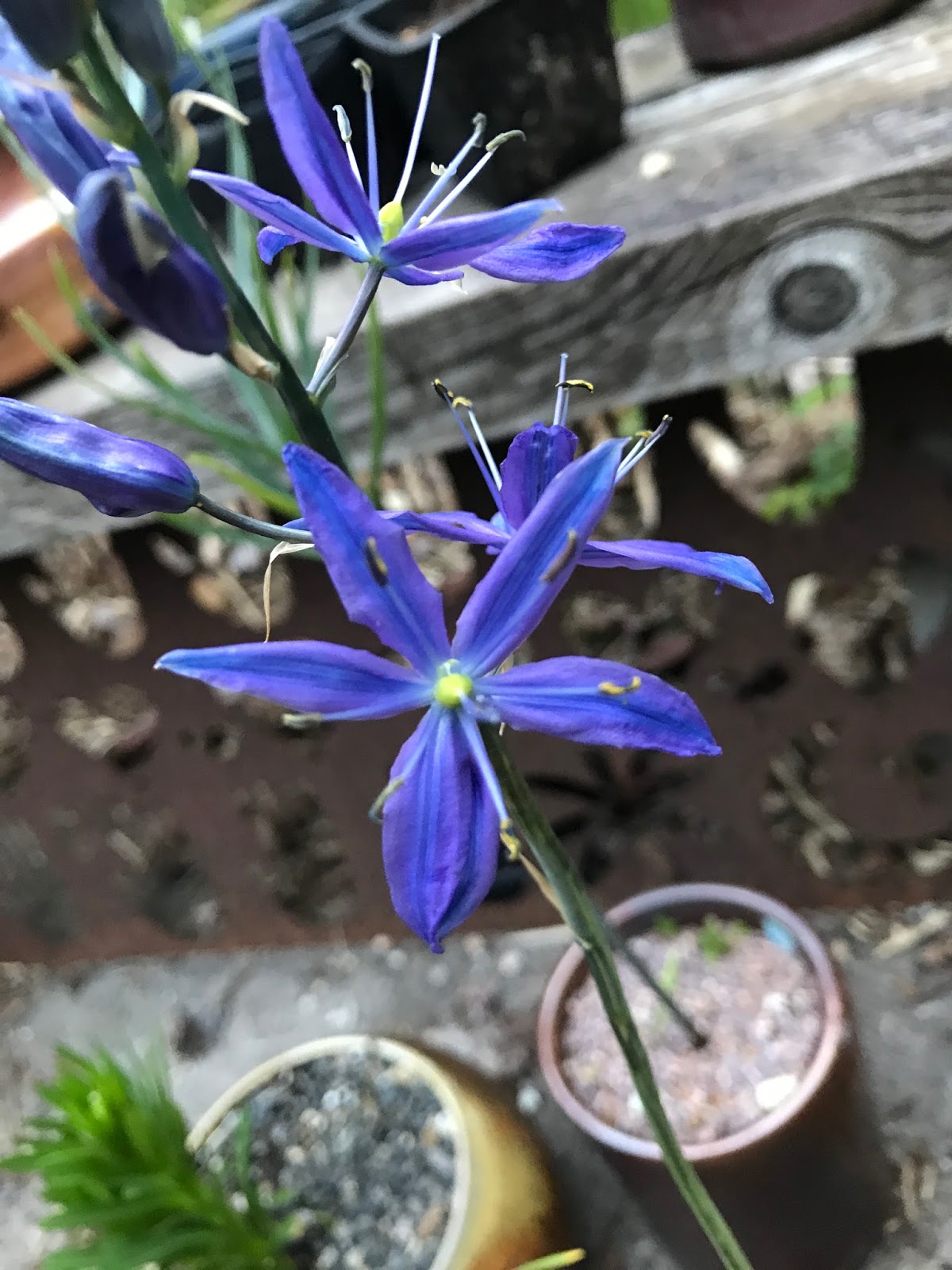
I've written in the past about Camas flowers- Camassia sp.  I have a breeding project underway to develop new color patterns in the flowers.  So far, I'm at the F1 hybrid stage, where all the plants are homogeneous and boring.  

Out in my garden is a growing hybrid swarm.  I grow the three main species of Camas- C. leichtlinii, C. quamash, and C. cusickii.  They bloom at roughly the same time, so they have all sorts of slutty inter-species sex, resulting in hordes of hybrid offspring.

One such plant bloomed for the first time this year, revealing its crazy flowers.


I'm not sure if I need to improve on that at all at this point.  I will propagate the shit out of this one, while mixing its genetics into my breeding project.  

Fun times!

Trillium

I inherited a large piece of wooded land from my dad.  Every year when we were kids, we would pick morels -Morchella sp, a delicious and easy-to-identify group of mushroom species that grow wild on the place.

In years past, I haven't been up there at the right time to pick them, so I scheduled a weekend camp-out this year.  I also wanted to check out the local wildflowers.  My friend Melissa went with me to see the property and check out the countryside.

We had a moderate harvest of black morels- Morchella elata.  We cooked them in a cast-iron skillet over charcoal- sauteed in butter.  So delicious :)


We also spent some time bushwhacking through the property to check on the health of the trees.  I think I'm going to have to get some logging done, since the fire danger is higher every year.  Some of the more moisture-sensitive speces like Abies grandis are starting to spontaneously die from the hotter and drier climate.  I need to start changing the mix of species to favor fire-resistant species such as Pinus ponderosa, Larix occidentalis, and Pseudotsuga menziesii.  

We chanced upon this Trillium ovatum plant.  


I'm not sure what to make of the variegation.  It may be viral, though I don't see other plants un the area with the same symptoms.  I will just watch it for a few years to see if it is stable.  If so, I will transplant it to my garden for further evaluation.  I may also go back for seed this summer and see what results from that.  


Thursday, March 28, 2019

Grass Widows

I recently went on a hike in Washington State, in an area well-known for its wildflowers.  One of the earliest species is Olsynium douglasii, or the grass widow.

While I was there, I viewed thousands upon thousands of individual plants.  Nearly all of the plants had flowers that were pinkish-purple.  


Whenever you are able to look at that many plants at once, you are bound to find some mutations and variations.  Several years ago, I saw a white-flowered form.  This time, I was not able to find it, which made me sad.  Luckily, I found another one in a different location.  


\


My favorites, of course, are the pale forms.  this one was just barely pink.  


The best one of the day was this one.  It had a lovely pink star in the center of the flower.  


I would be tempted to collect seed of these forms, and do some breeding.  The trouble is that this plant is a bitch to grow in wetter climates like mine.  I've bought plants from native plant nurseries in the past.  If I'm lucky, they last a couple of years and then die.  As wonderful as it would be to breed new forms of this plant, It doesn't seem worth it to me.  But I will continue to enjoy them on spring hikes!


Sunday, April 1, 2018

A Nameless Dwarf


I suppose I should have taken a more flattering picture of this.

Here:


A few years ago, I found an interesting broom in a Pinus ponderosa.  The resulting seedlings (those which were not eaten by the slugs) were not visibly dwarfed, except for this individual.  Its needles are less than 1/4 the length of a normal individual.  It is only three years old, but the internodes (the amount of growth each year) are quite small.  I think that this plant will end up being a true dwarf.

Its siblings are all much larger.  Only one is visibly typical.  Here it is, compared to the dwarf:


The others are still kind of ambiguous, though I think their true nature will become apparent during this growing season.  Some of them have more lateral buds than normal- another sign of dwarfing.


I think I may actually prefer to grow out seeds from brooms as a way to produce new plants.  The results are sometimes surprising.  I will have to get out in the woods and hunt down some more brooms with cones this year!

Monday, July 10, 2017

Evelyn's Find


Several years ago, Dad did some logging on his property.  He cut down a lodgepole pine that was crowding a western larch.  When the pine fell away, he noticed that the larch had an unusual, weeping form.  He told me that he wanted me to name it Evelyn's Find, after his friend Evelyn, who found the tree to be particularly delightful.

I was skeptical, as I mentioned in a previous post.  I couldn't tell if the weeping habit was just due to having been shaded out by a larger tree.  For the past several years, I've been on the fence about this one.

The other day, I happened to notice it.  The light was fading, so a good picture wasn't really possible with my phone.  I took the picture anyway. (I'll try getting a better one later.)


The branches gracefully weep, and have a spidery outline.  This tree has some potential, and needs to be grafted and observed further.

I think it is time to propagate 'Evelyn's Find'

Thursday, June 22, 2017

A Good Sign

Last year, I noticed a variegated leaf on my witch hazel.

This spring, the first two leaves from that shoot were plain green.  Then, the following leaf developed.


The question now is whether all the leaves will be like that, or just one leaf every third time :)

Either way, I think it will be a good plant.

As I've said before, only time will tell!

Thursday, May 25, 2017

Cherry Broom

I've been at my new job a couple of years now.  One of the best parts about it is that I get to drive to work on country roads every day.  When you drive along the same stretch of road, you get plenty of opportunities to spot unusual plants.

In the middle of last year, I discovered a broom in a hardwood tree on the road to work.  I would see it every day for a few months before I stopped to see what species it was.  It is on a treacherous stretch of road with very little room to pull over.

It turns out that it is a cherry tree- Prunus avium.  This species is from Europe, but it has naturalized in the US in places with suitable climates.  The wild ones grow into large forest trees with smaller fruit than cultivated varieties.


Here it is from a different angle.  


Last winter, I collected scions to store in the refrigerator until spring.  When I brought them out to graft, however, I saw that they had already come out of dormancy.  I grafted them anyway, just in case.  They failed.  I've found that plants will sometimes come out of dormancy at the right time, even when they are being held in a constant cold temperature in the refrigerator.  It makes me wonder what other cues in the environment trigger the internal clock of plants.  Had it already begun the process in late winter, so it just followed through?  Or does it just somehow count the days?

Luckily, fruit trees are much easier to graft than conifers.  I will have a second chance to graft this plant again in late summer.  At that time of year, I can do bud grafting, which is actually easier.  I have a much better success rate with Prunus while using this kind of grafting. 

I have to ask myself if brooms like this one, or the plum I found a couple of years ago, will yield anything useful at all.  There are many ornamental cultivars of cherries and plums.  These, if they even bloom- will have simple, single flowers.  As I'm writing this, I wonder if these brooms could be useful for dwarfing rootstocks.  Or perhaps I could use them as breeding stock to cross with the more ornamental varieties that already exist.  When you combine plant hunting with breeding projects, it seems that there are so many possibilities- far more than one can explore in a lifetime.


Thursday, May 11, 2017

Raw Materials

Sometimes, I find a mutation that isn't spectacular.  Normally, I might collect a cutting and just see how it does in the garden.  I may just let it grow there as an oddity.

Well, to be honest, it isn't like I am commercially producing these plants.  I have shared a few of them- but mostly, they just sit in my garden.  I have fantasized about starting a nursery, filled with odd forms of native plants- probably after I retire.  I don't know if such an enterprise would be very lucrative, but it might give me something to do when I'm an old man.

In the meantime, I just do this for fun.  I share my findings with friends and other plant geeks.  My understanding of the patent laws with plants is that you can't patent something you found in the wild.  If you spent effort breeding it, or it is a mutation you find among your cultivated plants, however, it is possible to patent the clone and make money from it.  Doing that doesn't seem likely to be worth the effort, unless you develop something really fucking amazing.

I have a few plant breeding projects going.  Hopefully, one will produce something spectacular in the future.  Mostly, I just want the satisfaction of making something spectacular.  it would be cool to see something in other people's gardens- people I don't even know- and be able to say, "oh yeah- that's my plant."

About 10 years ago, my friend Janet and I visited a stand of wild camas- Camassia quamash.  It is a native bulb in the lily family that was a food staple for North American native people.  I ate one once- raw.  It tasted like creamy dirt.  I wonder if I could sometime get an indigenous person to show me how you are supposed to cook them...

Wow.  I'm rambling this evening.  Allow me to get back to the point...

We found a camas with light blue flowers.  The petals had darker centers, and lighter color on the margins.  I collected the plant, since it was an interesting variant.  It wasn't particularly striking, but it was a cool flower.

A couple of years ago, I bought a pink-flowered Camassia leichtlinii (a larger species) from a vendor at a plant sale.  He had found it while plant-hunting, and had propagated loads of them to sell.

Three years ago, I decided to try crossing the pink-flowered one with my odd, light-blue form. Of course my light blue form died right after setting seed.  Damn it.

I've been waiting to see the flowers of the offspring until this week.  I have half a dozen plants, and one of them bloomed this year.


So far, the results aren't exactly jaw-dropping.  It could be my imagination, but I think I see some possibility in this line of breeding, however.  As the other plants start blooming next year, I will cross them.  In such crosses, the F2 hybrids are when you start to see variation.  My eventual goal would be bi-colored flowers.  I would like to see pink on the outside margins of the petals with a blue streak down the middle.  You can see a subtle version of that in these flowers.  A few generations of breeding might make that really pop out.

At any rate, projects like this give me something to work on during times when I can't find any new mutations.

Monday, April 24, 2017

The Return of the Light

It has been a long, wet winter.

We had repeated ice storms, and wind strong enough to tear shingles off my roof.  I have had a rough time of it this year.  I tend to have trouble getting through the last few months of the winter anyway, and this year's crappy events- from the election of an idiot to the death of my father- have made getting through it all the more arduous.  

Spring has come late.  While looking at photographs of my garden in years past, I have noticed how delayed the season is.  For example, my asian pear was in full bloom on March 21st a few years ago.  This year, it didn't reach full bloom until mid-April.  

I have probably never been so glad to see the spring flowers come up in my garden.  As the days grow longer and I spend more time out in the garden, it is almost like I can feel life flowing back into my body.  

Even though it is still almost as rainy as it is in the middle of the winter, I adore the longer daylight hours.  My drive home from work is through a river canyon which is shady and dark in the winter.  One day I counted ten waterfalls on my drive home, however. 

Last week, as I was driving through the river canyon, a flash of yellow jumped out at me from the cliff beside the road.  It looked quite similar to the bright yellow foliage of various landscaping shrubs around town, so I didn't really  notice it at first.  At some point over the next few days, I realized that it was growing out of the side of the cliff- not near anyone's yard or garden.

Today I stopped.  


It is a Philadelphus lewisii- our native mock orange.  As a kid, this was one of my favorite plants; its heavy, sweet fragrance was bewitching.  (Oh fuck- I used one of those words that fluffy garden writers use.  I fucking hate that style of writing.  Gross.)  

While there are plenty of cultivars of the Eurasian species of Philadelphus, there are not many of our native species.  I'm cautiously optimistic about this plant.  The foliage is luminous- it grabs your attention from the side of the road.  There is always the chance that the plant is sick, however.  I don't remember seeing herbicides being sprayed on that road, but I may have failed to notice.  Sometimes I've seen plants develop a sickly yellow color after they've survived 

This plants looks pretty healthy, however.  


I took cuttings and stuck them this evening.  If it takes, I may name it something cheesy but fitting, such as 'Return of Light'.

Wish me luck.

Friday, December 30, 2016

Dad

I lost my dad in November.

I wasn't going to post anything about this tree, since I may have trespassed in order to propagate it.  I named it after him, however, so I feel like I should post it now.

When I was a kid, I remember riding by this tree on the school bus.  I remember seeing it in the 90s and wondering if someone could graft it.  This was long before I knew how to propagate conifers, so I didn't try.

I had largely forgotten about the tree until Dad told me about it about 10 years ago.  He and a friend had some car trouble right by the tree, and they noticed its unusual form.


It is a Western Larch, Larix occidentalis, of which there are only a couple of cultivars.  That winter, I got some scions and grafted it up.  Only one took, and it has been growing in my garden ever since. While the original is maybe 20 feet high, the one here is only about three feet high.  Last year the beavers felled a poplar onto it, breaking the leader.  I was able to train up a new leader, so it is still fine (if  a bit ugly at the moment.)

I named it after Dad because we both had a love of trees- conifers in particular.

I remember when I was six, Dad and I went for a walk in the woods behind our house.  I remember telling him that I had a favorite tree, and that I wanted to show it to him.  He told me that he already knew which one it was.  He was right- it was a Pinus monticola that lived behind our house in the woods.  The species had been severely impacted by the accidental introduction of White Pine Blister Rust in the first half of the 20th century.  Dad and I both had a love for that species. They are handsome trees- usually very straight with evenly spaced terraces of branches.  The needles are soft and blue, and the fragrance of the foliage and sap is pleasing.  On the property where I grew up, there were survivors of the plague.  Dad always spoke of them with a special reverence.

During the past 25 years, we planted thousands of tree seedlings on our property- many of which were Pinus monticola.  Because the species was once very commercially valuable for window and door frames, there were significant efforts made to breed disease-resistant strains.  The seedlings we planted were from those strains.  It is fun to watch the species re-establish itself in the forests on our property.

I wasn't able to help Dad plant seedlings during the past two years.  He continued to plant thousands- even in his 80s.  His commitment to the land and the future was strong, even though he knew he wouldn't' be around to see it.

Dad was always a source of strength and support for me.  He encouraged me through my career troubles in the past several years, and went with me on several ridiculous plant outings.

Things have been difficult since his passing.  I often find myself thinking about the time we got stuck in the snow a few years back.  I was scared and didn't know what to do.  I clearly remember him saying, "Well, we just have to keep digging" as he worked to get the truck unstuck.  I will never forget his calm and pragmatic attitude in the face of a very serious situation.  I will miss his wisdom and perspective.

Dad was a kid during the Great Depression.  His father had abandoned the family when he was young, and Dad went to work in a sawmill at 15 to help support the family.  His work ethic was legendary- they just don't make people like that anymore.  In the weeks since his passing, I've heard from many of his friends and acquaintances.  Everyone talks about what a crazy hard worker his was- and about his willingness to help other people out.

Growing up, I was raised to believe that you just helped people when they needed it.  If your neighbors needed help putting up hay or doing some work on their house- you just went and helped them.  In the future, they would do the same for you.  I feel that we are losing those values and social structures.  In remembrance of my dad, I would like to help keep those values alive.  I plan to volunteer more, and to help my neighbors and friends with more projects and work around their places.

The other way in which I want to further my Dad's legacy is by propagating this larch.  If you are a conifer person and are interested in scions, please let me know.  I want to share this tree far and wide to honor Dad's memory.

I expect it to slowly make its way out into the conifer trade.  Keep an eye out for Larix occidentalis 'Ray Griffith'.


Tuesday, October 4, 2016

Pending Variegation


     This summer, I happened to notice a single variegated leaf on one of the witch hazels in my garden.  The plant is Hammamelis X intermedia 'Diane', a hybrid with orange flowers.  


     It is odd to see a single variegated leaf like this.  Is it a virus?  If so, why hasn't it spread to other parts of the plant?  Is it a mutation?  If so, was it just the leaf that mutated- or is the auxiliary bud above the leaf also mutated?

     I've had similar mutations in my garden before, only to find that they burn in the sun, or are not stable.  My hope with this one is tempered with experience.  Next spring, I will prune that branch to the bud above that leaf, in the hopes that the variegation will continue.  As I'm typing this, I realize that I need to mark that bud so that I remember which one it is.  When the plant loses its leaves this fall, they will all look the same.


     I imagine a whole bush with leaves like this.  The pattern looks almost like an aerial photograph- with fields and forests.  I might have to name it something that pertains to maps- if it turns out to be a keeper, that is.   

Wednesday, September 7, 2016

Getting Hit With the Different Stick

I once worked with a student who had a whole stack of unusual health issues.  I'd list them, but they are so unique that I should keep my mouth shut about them for the sake of confidentiality.

I used to say that he got hit with "the different stick"- a play on the expression to get "hit with the ugly stick".   It wasn't meant in a negative way...  I was just amazed at the chances of being that different in that many ways.  I've often felt that way, myself.

A former coworker once visited my garden, and I pointed out a raspberry sport that I had found with gold foliage.  "How did you even see that?" he asked.  He said that he would have assumed it was sick and pulled it out.  He then went on to observe our respective attitudes toward students with cognitive differences.  He said that he was more like to look at what was "wrong" with a student- whereas I was more likely to think, "what a wonderful mutation!"

I think he was on to something.

I was hit with the different stick a few times, myself.  This summer, I've been dealing with a mutation that I have.  I figured Id talk about that this time :)

This is a picture of my fouth great grandmother.  Notice her left eye.  The condition is known as ptosis.  It has a few different causes.  I don't know if hers is the same as mine or not.  I have another female ancestor on the other side of my family who had the same issue.  I don't recall if it was in the other eye or not :)

I have ptosis in both eyelids.  Mine was caused by the my eyelid muscles failing to develop when I was a baby.

When I was a kid, I was able to raise my eyelids by raising my eyelids.  You can't get them very far open that way, so I always had very droopy eyelids.  When I was 14, I had surgery to correct it.  The doctor used silicone slings to tie my eyelids up to my eyebrow muscles.  I can raise my lids by raising my eyebrows.  It still doesn't look all that natural, but I have a much larger field of vision.

Over the past few years, the sling in my left eye failed.  I couldn't open that eye very far, and my peripheral vision was getting pretty restricted.  I finally mentioned it to the doctor, and I was scheduled for surgery to repair it.

The procedure was performed while I was conscious, but sedated.  I can't say it was pleasant :)


The doctor made an incision across my eyelid, and then stitched the silicone band to the tarsis (the firmer, inside tissue of the eyelid).  Then, he used HUGE needles to thread the silicone under the skin to the small incisions above my eyebrow.  The doctor actually complained about how dull the needles were several times.  At one point, they had to increase the tranquilizer they were giving me, because it started to hurt a lot.

It healed up fairly quickly, and it looks better than the other eyelid does.  I almost want the right one to fail so I can have him redo it :)